On January 10, 2026, the Zhuhai Qin—a new intelligent truss-type aquaculture platform developed by the Southern Marine Science and Engineering Laboratory (Zhuhai) in collaboration with Sun Yat-sen University—was officially launched at the Veolia Shipyard. This launch marks a key breakthrough in transforming China’s deep-sea aquaculture equipment toward digitalization, intelligence, and greener practices.
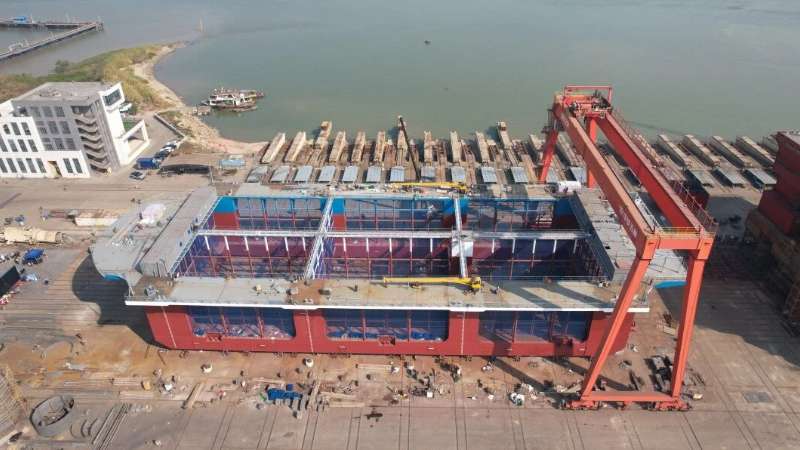
Equipped with a range of innovative technologies, Zhuhai Qin has established a new paradigm for deep-sea aquaculture. Measuring 110 meters in length, 40 meters in width, and with a 15-meter draft, it encloses over 60,000 cubic meters of water within six independent net cages. Adopting a semi-submersible truss structure, it is designed to withstand typhoons of up to Grade 15 and operate reliably in the complex marine environment of the South China Sea. By incorporating photovoltaic power generation, automated UAV feeding systems, and a 5G-enabled management system, the Zhuhai Qin enables fully modern, unmanned, and intelligent aquaculture operations—from feed storage to real-time environmental monitoring. As a benchmark in industry-university-research integration, it tackles long-standing industry challenges, achieves breakthroughs in core domestic technologies, and supports zero-carbon operations—fully aligning with an ecological-priority development approach.
A key domestic innovation is the platform's truss-type slow-flow zone design. The multi-pillar structure creates a calm, low-current area inside the platform, offering fish a safe haven during storms, which reduces stress and improves survival rates and overall growth quality. Another pioneering feature is the distributed foldable self-elevating net cage, which allows a single cage to be harvested within one hour—solving traditional problems of low efficiency and physical damage to fish during harvest.
The successful development of the Zhuhai Qin demonstrates SML’s strategic focus, under its “Four Research Missions” framework, on translating research into practical applications—a result achieved through close industry-university-research collaboration. Guided by the principle of co-construction, sharing, and mutual benefit, SML’s Marine Ranching and Healthy Aquaculture Mission teamed up with Associate Professor Huang Shuo’s group from School of Ocean Engineering and Technology of SYSU. For years, the joint team focused on pressing industry issues such as poor storm resistance, net fouling, harvesting difficulties, and low automation levels in deep-sea farming. Their work has successfully addressed the poor adaptability and high operational costs associated with traditional aquaculture equipment.
The launch ceremony was attended by officials from relevant departments and institutions, including the Zhuhai Bureau of Ocean Development, Zhuhai Bureau of Science and Technology Innovation, Zhuhai Wanshan Marine Development Experimental Zone, School of Ocean Engineering and Technology of SYSU, Zhuhai Ocean Development Group Co., Ltd., and Guangdong Dalinyang Marine Biotechnology Co., Ltd, and SML. The attendees fully recognized the project’s role in advancing the marine aquaculture industry and expressed confidence in the high-quality development prospects of deep-sea aquaculture.
Upon commissioning, the platform will support the large-scale farming of high-value fish such as golden pomfret and grouper, contributing to the building of a "Blue Granary." This deep-sea aquaculture model will help reduce nearshore pollution and protect coastal ecosystems. Simultaneously, as an offshore research and experimentation base, it will also stimulate growth in related sectors, including marine engineering and fish breeding.
Rooted in its "To be the first or the best" ethos and its "three-wheel drive" strategy—serving national needs, pursuing scientific frontiers, and supporting local development—SML continues to deepen its focus on marine ranching and sustainable aquaculture. The launch of the Zhuhai Qin paves the way for further industry-academia partnerships and faster translation of research into real-world solutions. Its journey promises to add new momentum to China’s maritime development and open a new chapter in the future of ocean farming.